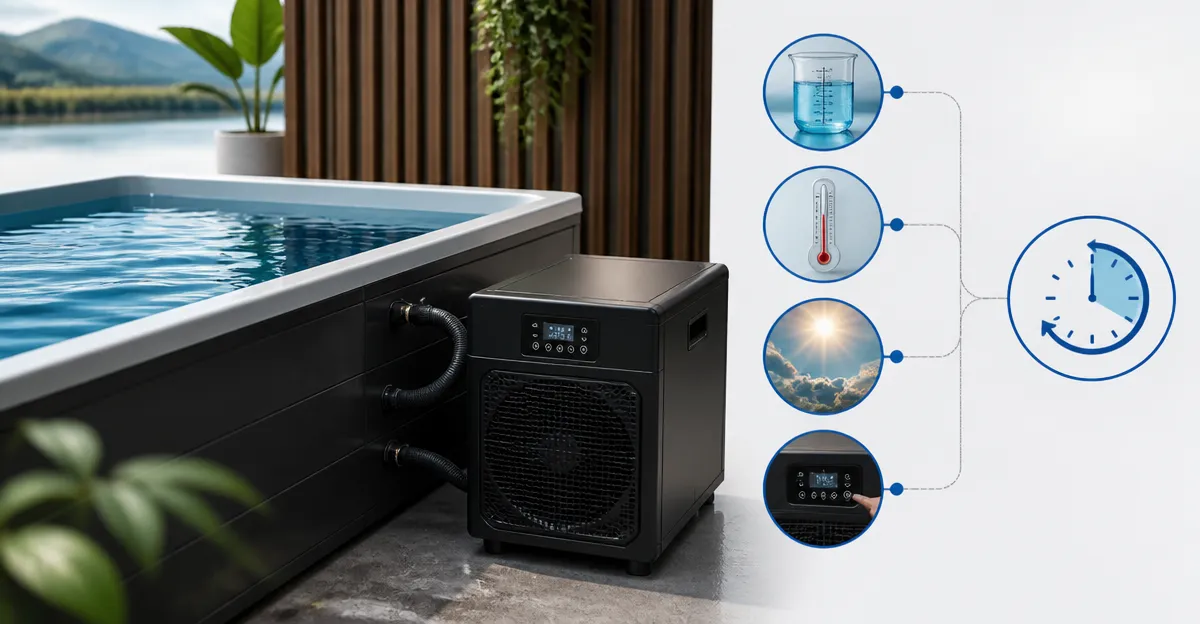
How to Estimate How Long a Cold Plunge Chiller Takes to Cool Water: Typical Timelines, Key Factors & Speed‑Up Tips
Introduction
Understanding how long a cold plunge chiller requires to reach the desired temperature is essential for planning effective recovery sessions. This guide explains the physics behind cooling, outlines the variables that influence speed, and provides a step‑by‑step method to calculate an accurate estimate. Readers will also learn practical techniques to accelerate cooling without compromising safety or equipment longevity. By the end of the article, one can schedule plunges with confidence and avoid unnecessary waiting periods.
What You'll Need
- Cold plunge tub or inflatable container (capacity up to 80 gallons)
- Thermometer (digital or floating pool thermometer)
- Insulating cover or blanket for the tub
- One of the recommended chiller units (first mention linked below)
- Power source with appropriate voltage (110 V or 220 V as required)
- Optional: external pump, filter media, and insulated hoses (included with most kits)
Step 1: Determine Your Starting Conditions
The first calculation requires the initial water temperature, the target temperature, and the volume of water in the tub. Measure the water temperature with a reliable thermometer and record the value in degrees Fahrenheit. For example, a 70‑gallon tub filled with water at 78 °F that you wish to cool to 45 °F has a temperature differential of 33 °F. This differential directly influences the cooling load that the chiller must overcome.
When selecting a chiller, consider the capacity of the unit relative to your tub size. The EONIX Ice Bath Chiller handles up to 79 gallons and maintains temperature within a 1 °F variance, making it suitable for large inflatable tubs. It is priced at $289.99 and holds a perfect 5‑star rating from five reviewers, indicating reliable performance for serious users.
Step 2: Identify the Chiller's Cooling Capacity
Each chiller specifies a cooling capacity measured in BTU/hr or, more simply, the volume of water it can cool per hour to a target temperature. The AS ColdPlunge Chiller advertises rapid cooling down to 42 °F for tubs up to 79 gallons, with a 1/3 HP compressor that delivers consistent performance. It costs $399.00 and carries a 4.2‑star rating from 165 reviews, reflecting broad user satisfaction.
For a more budget‑friendly option, the AzureaFlow Ice Bath Chiller cools up to 66 gallons to 42 °F and is priced at $299.99 with a 4.3‑star rating. Its dual‑fan design and pure copper cooler improve heat exchange efficiency, which can reduce cooling time by up to 15 % compared with less optimized units.
Step 3: Calculate Theoretical Cooling Time
Use the following simplified formula to estimate cooling duration: Time (hours) = (Volume × ΔT × Water Specific Heat) / (Chiller Cooling Power). Water's specific heat is 1 BTU/(lb·°F). Convert gallons to pounds (1 gallon ≈ 8.34 lb). For a 70‑gallon tub with a 33 °F drop, the heat removal required equals 70 × 8.34 × 33 ≈ 19,300 BTU.
If the chiller delivers 4,000 BTU/hr (typical for a 1/3 HP unit), the estimated time is 19,300 / 4,000 ≈ 4.8 hours. Real‑world factors such as ambient temperature, insulation, and water circulation will modify this figure, but the calculation provides a solid baseline.
Step 4: Account for Ambient Temperature and Insulation
Higher room or garage temperatures increase the thermal load on the chiller. A difference of 10 °F between ambient air and water can add roughly 10 % to cooling time. To mitigate this, cover the tub with an insulating blanket when the chiller is not actively circulating water. The FADHOLE Cold Plunge Chiller includes insulated hoses and a cover that help retain cold temperatures, and it is priced at $329.99 with a 4.7‑star rating.
Positioning the chiller in a cooler part of the house, such as a basement, can further reduce the thermal gradient. Ensure adequate ventilation around the unit to avoid overheating, which can cause the compressor to cycle less efficiently.
Step 5: Optimize Water Circulation
Uniform water movement prevents stratification, where the surface remains warm while the bottom is cold. Most recommended units integrate a built‑in pump and filter that continuously circulate water. The PlungeFit 1 HP Ice Bath Chiller provides a powerful external pump and a 20‑micron filter, delivering rapid and even cooling for up to 230 gallons. Although priced at $849.00, its 1 HP compressor can cut cooling time by roughly half compared with 1/3 HP models.
When using a chiller without an integrated pump, add a submersible pump (often included) to ensure water passes through the cooling coil at the manufacturer‑specified flow rate. Consistent flow maximizes heat exchange efficiency and shortens the overall cooling cycle.
Step 6: Set the Desired Temperature and Activate the Unit
Program the chiller to the target temperature using its digital controller or touchscreen interface. Most units allow precise adjustments in 1 °F increments. The EONIX Ice Bath Chiller features an intuitive digital controller that remembers the last setting, providing a “set and forget” experience.
After setting the temperature, start the chiller and verify that the pump is circulating water. Monitor the thermometer periodically; the chiller will typically display a real‑time temperature readout. When the water reaches within 1–2 °F of the target, the unit will enter a maintenance mode, cycling on and off to preserve the setpoint.
Step 7: Record Actual Cooling Time for Future Reference
Track the start time, ambient conditions, and the moment the water reaches the target temperature. This data creates a personal benchmark that can be refined with each subsequent use. Over time, users can adjust insulation, flow rate, or ambient placement to improve efficiency based on empirical results.
Maintaining a simple log—either on paper or in a spreadsheet—helps identify patterns such as longer cooling periods during summer months or after adding warm water for a refill. Adjustments can then be made proactively, ensuring consistent readiness for each plunge.
Tips & Pro Tips
- Pre‑chill the tub. Fill the tub with cold tap water and add a few ice cubes for the first 30 minutes; this reduces the initial temperature differential.
- Use a timer. Set the chiller to start several hours before the intended plunge; many users find a 4‑hour lead time sufficient for a 70‑gallon tub.
- Seal gaps. Apply waterproof tape around hose connections to prevent warm air ingress.
- Maintain the filter. Rinse the reusable metal or mesh filter weekly to preserve flow rate; clogged filters can increase cooling time by up to 20 %.
- Leverage night‑time cooling. Ambient temperatures drop after sunset; running the chiller overnight can shave off an hour or more from daytime cooling cycles.
Troubleshooting
Problem: Water temperature stalls above target.
Solution: Verify that the pump is operating and that the filter is clean. Check for air bubbles in the hose line; purge by briefly opening the bleed valve if available.
Problem: Excessive noise or vibration.
Solution: Ensure the chiller sits on a stable, level surface. If noise persists, consider adding vibration‑absorbing pads beneath the unit. The EONIX Ice Bath Chiller operates below 40 dB, making it a quiet choice for residential settings.
Problem: Unit fails to start after power outage.
Solution: Reset the digital controller according to the user manual and confirm that the power switch is engaged. If the problem continues, contact the manufacturer’s support—most brands, including AS ColdPlunge, offer 24‑hour response times.
Conclusion
Estimating the cooling time of a cold plunge chiller involves understanding water volume, temperature differential, chiller capacity, and environmental factors. By following the structured steps outlined above, users can generate reliable timelines, implement speed‑up strategies, and maintain optimal performance of their equipment. Accurate estimates enable seamless integration of cold therapy into daily routines, enhancing recovery, reducing inflammation, and supporting overall wellness.
Products Mentioned in This Guide
Frequently Asked Questions
How long does a typical cold plunge chiller take to cool water from room temperature to 50°F?
Most 40‑80 gallon units reach 50°F in 2‑4 hours, depending on ambient temperature and insulation.
What are the main factors that affect a chiller’s cooling time?
Water volume, starting temperature, ambient temperature, chiller capacity (BTU/kW), and insulation quality all influence cooling speed.
How can I speed up the cooling process without damaging the chiller?
Use a tight insulating cover, pre‑chill the water, and ensure proper water circulation with a pump.
Is it safe to run a cold plunge chiller continuously to maintain temperature?
Yes, continuous operation is safe if the unit is rated for 24‑hour use and proper ventilation is provided.
Can I estimate cooling time with a simple formula?
Approximate time ≈ (water volume × ΔT × 4.2 kJ/kg·K) ÷ (chiller power × efficiency), then adjust for insulation losses.