How to Size a Cold Plunge Chiller for a 200‑500 Gallon Plunge Pool: Step‑by‑Step BTU & Cooling Capacity Guide
Introduction
Cold‑water immersion has become a cornerstone of recovery for athletes, wellness enthusiasts, and therapeutic users. Selecting a chiller that can reliably maintain the desired temperature for a 200‑500 gallon plunge pool requires careful calculation and proper equipment. This guide will teach the reader how to determine the required cooling capacity in BTU, match that capacity to a suitable chiller, and install the system safely. By following these steps one can achieve consistent cold therapy without excessive energy use or equipment failure.
What You'll Need
- Accurate measuring tools (tape measure, volume calculator)
- Circulation pump such as the VIVOSUN 800GPH Fountain Water Pump
- Chosen chiller (options listed in the guide)
- Thermometer or digital temperature probe
- Insulated hoses, clamps, and basic plumbing tools
- Safety equipment (gloves, goggles)
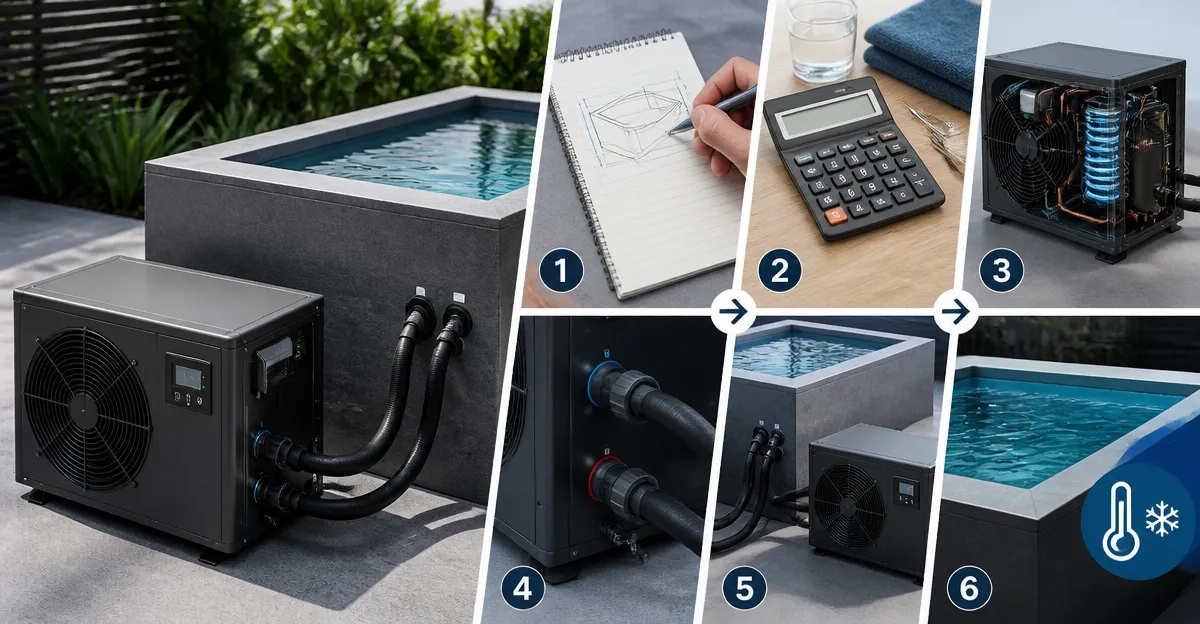
Step 1: Determine the Exact Volume of Your Plunge Pool
The first step is to confirm the water volume in gallons, because BTU calculations are directly proportional to volume. Measure the length, width, and depth of the pool in feet; multiply length × width × average depth to obtain cubic feet, then multiply by 7.48 to convert to gallons. For irregular shapes, divide the pool into simple geometric sections, calculate each section separately, and sum the results. Record the final figure; this number will be used throughout the guide.
Example: A rectangular pool that is 8 ft long, 5 ft wide, and an average depth of 4 ft contains 8 × 5 × 4 = 160 ft³, which equals 160 × 7.48 ≈ 1,197 gallons. For a larger 12 ft × 8 ft × 5 ft pool the volume is 12 × 8 × 5 = 480 ft³, or about 3,590 gallons, which exceeds the target range and would require a larger commercial‑grade chiller.
Step 2: Calculate the Required BTU Removal
BTU (British Thermal Unit) quantifies the amount of heat that must be removed each hour to achieve the target temperature. The basic formula is:
BTU/hr = Volume (gal) × 8.34 (lb/gal) × ΔT (°F) ÷ 1 hour
Where 8.34 is the weight of one gallon of water in pounds, and ΔT is the temperature drop from ambient to desired plunge temperature. For a pool in a 85 °F environment that you wish to keep at 55 °F, ΔT equals 30 °F.
Applying the formula to a 300‑gallon pool: 300 × 8.34 × 30 ≈ 75,060 BTU/hr. This value represents the maximum cooling load; selecting a chiller with a rating of 10‑20 % higher provides a safety margin for heat gain from sunlight, pumps, and ambient fluctuations.
Step 3: Choose an Appropriate Chiller Based on BTU Capacity
With the BTU requirement known, compare it to the specifications of available chillers. The products reviewed below each list a cooling capacity in gallons per hour (GPH) or BTU, which can be converted using the same water weight factor.
- AS ColdPlunge 1/3HP Chiller – Designed for home tubs, it cools water down to 42 °F and includes a built‑in pump. At 1/3 HP it can handle up to approximately 400 gallons with a typical removal rate of 45,000 BTU/hr, making it suitable for the lower end of the target range. Price: $399.00, Rating: 4.3/5 (180 reviews). AS ColdPlunge Chiller
- BAOSHISHAN 1/10 HP Aquarium Chiller – Rated for 42‑gal tanks but can be up‑scaled with larger pumps; its 1/10 HP compressor delivers roughly 30,000 BTU/hr, appropriate for 200‑gal pools when paired with a high‑flow pump. Price: $279.99, Rating: 4.2/5 (503 reviews). BAOSHISHAN Aquarium Chiller
- Pod Chiller 2.0 – Offers Bluetooth control and a 20‑micron filtration system. Its cooling capacity reaches approximately 60,000 BTU/hr, comfortably covering pools up to 500 gallons. Price: $999.99, Rating: 4.1/5 (162 reviews). Pod Chiller 2.0
- Active Aqua 0.25 HP Hydroponic Chiller – Provides 3,010 BTU/hr per hour and is rated for 40‑92 gallons, but with external pumps it can be pushed to 150‑200 gallons. Its pure‑titanium evaporator ensures durability in saltwater environments. Price: $614.37, Rating: 4.1/5 (352 reviews). Active Aqua Hydroponic Chiller
For a 300‑gallon pool requiring ~75,000 BTU/hr, the Pod Chiller 2.0 provides the most headroom, while the AS ColdPlunge Chiller may need supplemental cooling or reduced ΔT. The BAOSHISHAN unit is best suited for pools at the lower end of the range when paired with the VIVOSUN 800GPH Fountain Water Pump to increase flow.
Step 4: Install the Circulation Pump
A reliable pump ensures uniform water temperature and prevents hot spots. The VIVOSUN 800GPH Fountain Water Pump offers up to 800 GPH, adjustable flow, and a compact, detachable design that can be positioned on flat, angled, or vertical surfaces. Its 50 W power draw and 10‑ft lift height are sufficient for most residential plunge pools.
Installation steps:
- Place the pump at the deepest point of the pool to maximize lift.
- Connect the inlet hose to the pump’s suction port, ensuring a snug fit; the pump’s detachable design allows tool‑free assembly.
- Route the outlet hose toward the chiller inlet, using the provided hose clamps to prevent leaks.
- Secure the pump electrically to a GFCI outlet and test the flow by turning the pump on; adjust the knob to achieve the recommended 400‑600 GPH circulation rate for a 200‑500 gal pool.
Proper pump placement reduces the chiller’s workload, leading to lower energy consumption and longer component life.
Step 5: Connect and Configure the Chiller
Follow the manufacturer’s wiring diagram, but the general procedure is similar for all listed chillers. Begin by positioning the chiller on a flat surface with at least 6 inches of clearance for airflow, as recommended by the BAOSHISHAN unit. Attach the insulated hoses to the chiller’s inlet and outlet ports; the AS ColdPlunge kit includes quick‑connect fittings, while the Pod Chiller 2.0 provides a dual‑filtration loop.
Steps:
- Prime the pump by filling the inlet hose with water to eliminate air pockets.
- Secure the hose clamps and verify that the hose lengths do not exceed the manufacturer’s recommendations (typically 3 ft for the AS ColdPlunge).
- Plug the chiller into a dedicated 120 V outlet; for units with built‑in pumps, ensure the circuit can support the combined amperage.
- Use the chiller’s control interface (touchscreen for AS ColdPlunge, Bluetooth app for Pod Chiller 2.0, or analog dial for BAOSHISHAN) to set the target temperature, usually 55 °F for therapeutic use.
- Activate the circulation pump; the chiller will begin extracting heat and expelling it through its condenser fans.
Allow the system to run for at least one hour before taking temperature readings; this ensures the chiller has reached steady‑state operation.
Step 6: Verify Performance and Adjust Flow
After the initial cooldown, measure the water temperature at multiple points (surface, mid‑depth, and near the pump) to confirm uniformity. If temperature variance exceeds 2 °F, increase pump flow or adjust the chiller’s set point by 1‑2 °F. The VIVOSUN 800GPH Fountain Water Pump offers a flow‑rate knob that can be fine‑tuned without additional tools.
Record the energy consumption using a plug‑in power meter; this data helps evaluate long‑term operating costs and may influence future upgrades.
Tips & Pro Tips
- Install a floating insulated cover on the pool when not in use; this reduces heat gain and improves chiller efficiency.
- Place the chiller in a well‑ventilated area away from direct sunlight; the Pod Chiller 2.0 performs best when ambient temperature is below 80 °F.
- Schedule regular filter cleaning; the built‑in metal mesh filter of the AS ColdPlunge and the 20‑micron filter of the Pod Chiller 2.0 should be rinsed weekly to prevent clogging.
- Consider a secondary temperature sensor with alarm capability for safety; sudden temperature spikes can indicate pump failure.
- When using the Active Aqua Hydroponic Chiller for a plunge pool, purchase an external pump (e.g., a 550 GPH canister pump) to meet the required flow, as the unit does not include a pump.
Troubleshooting
| Problem | Possible Cause | Solution |
|---|---|---|
| Water not reaching target temperature | Insufficient BTU capacity or excessive heat gain | Upgrade to a higher‑capacity chiller (e.g., Pod Chiller 2.0) or add a pool cover. |
| Air bubbles in the system | Improper priming of pump | Turn off power, disconnect hoses, fill inlet hose with water, then reconnect. |
| Excessive noise | Vibration from pump or chiller fans | Place rubber pads under pump, ensure chiller has 6‑inch clearance for airflow. |
| Filter clogs frequently | Debris entering water | Install a pre‑filter screen at the pump inlet and clean weekly. |
Conclusion
Properly sizing a cold plunge chiller involves measuring pool volume, calculating BTU removal, selecting a unit with adequate capacity, and ensuring robust water circulation. By following the six detailed steps one can achieve a stable therapeutic temperature for pools ranging from 200 to 500 gallons. The recommended products—particularly the VIVOSUN 800GPH Fountain Water Pump and a chiller that matches the calculated BTU load—provide reliable performance while remaining cost‑effective. Implementing the tips and troubleshooting advice will further extend system longevity and user satisfaction.
Products Mentioned in This Guide
Frequently Asked Questions
How do I calculate the BTU rating needed for a 200‑500 gallon cold plunge pool?
Multiply the pool volume (gallons) by the desired temperature drop (°F) and then by 8.34 (the BTU needed to cool one gallon by 1°F).
What size chiller is recommended for a 300‑gallon plunge pool?
A chiller rated around 6,000‑8,000 BTU/hour will typically maintain a 10‑15°F drop in a 300‑gallon pool.
Why is a circulation pump essential when sizing a cold plunge chiller?
The pump ensures even water flow, allowing the chiller to work efficiently and maintain a consistent temperature throughout the pool.
Can I improve energy efficiency of my cold plunge system?
Yes—insulate hoses and the pool, use a timer or thermostat, and select a chiller with a variable‑speed compressor to match load demand.
What safety equipment should I use when installing a cold plunge chiller?
Wear gloves and goggles, and ensure all electrical connections are GFCI‑protected to prevent shocks during installation.